

If you’ve ever hesitated with a knife in hand, unsure where to start or worried you’ll do it wrong—you’re not alone.
Most beginners feel uneasy around sharp blades, which makes prep slower, less precise, and, let’s be honest, not very fun. But confidence in the kitchen starts with mastering the tool you use most: your knife.
That’s exactly what this guide is here to help with. We’ve broken down years of culinary training into a clear, beginner-focused approach that emphasizes safety, control, and consistency.
In this article on knife skills for beginners, you’ll learn how to handle your knife correctly, make efficient cuts, and build the foundation every cook needs. Nothing fancy—just the essential techniques that turn hesitation into instinct.
We’ve focused on what matters first: good habits, smart handling, and the key moves you’ll use every day—no fluff, no pressure.
By the end, you won’t just feel safer. You’ll feel ready.
Choosing Your Tools: The Beginner’s Essential Knives
Let’s skip the flashy 12-piece knife set (yes, the one gathering dust on every wedding registry). When you’re just learning your way around the kitchen, less truly is more—especially when it comes to blades.
The Workhorse: The Chef’s Knife (8-inch).
If you’re only buying one knife, make it this one. From dicing onions to slicing steak, it handles over 90% of daily tasks. It’s like the Beyoncé of kitchen tools—versatile, reliable, iconic. Pro tip: Look for a knife with a comfortable grip; it’ll become an extension of your hand over time.
The Detailer: The Paring Knife (3-4 inch).
Tiny but mighty. Use it for precision work—peeling apples, deveining shrimp, trimming mushrooms. Imagine the chef’s knife as the SUV and the paring knife as the scooter—nimble, quick, and perfect in tight spaces.
The Specialist: The Serrated Knife.
It’s built for bread and delicate produce like tomatoes. (Ever tried slicing fresh sourdough with a chef’s knife? Goodbye, crust.) Its saw-like edge tackles soft-inside, tough-outside foods effortlessly.
Why Start Simple?
Big knife blocks look nice on countertops, but most are clutter. With these three essentials, you can master core techniques without spending a fortune or getting overwhelmed. Focus on control—and sharpening your knife skills for beginners.
Safety First: The Two Grips That Will Change Your Cooking
Mastering essential chopping techniques not only enhances your knife skills but also sets the stage for delicious dishes, making it a perfect prelude to exploring the variety of flavors in our cooking recipes at Cwbiancarecipes – for more details, check out our Cooking Recipes Cwbiancarecipes.
If you’ve ever tried slicing a tomato only to watch it slip out from under your blade (and nearly take your dignity with it), it’s time you learned the real fundamentals that chefs swear by.
Mastering proper knife technique isn’t just about looking cool on camera (though, let’s be honest—it helps). It’s about safety, speed, and dramatically improving your results in the kitchen.
Here are the two essential grips that can instantly level up your knife confidence—and prevent painful accidents:
1. The Claw Grip (The Guiding Hand)
Tuck your fingertips under and rest your knuckles forward to guide the blade. It might feel awkward at first, but it puts your delicate digits safely out of the knife’s path. What’s in it for you? Fewer close calls and surprisingly straighter cuts. Pro tip: Practice with slower foods like cucumbers or zucchinis before tackling onions.
2. The Pinch Grip (Your Controlling Hand)
Instead of gripping the handle alone, pinch the blade—right where it meets the handle—between your thumb and index finger. Wrap the rest of your fingers around the handle. This gives you far better control and precision, especially when chopping, dicing, or slicing. (Think of it as the difference between driving with two fingers vs. both hands on the wheel.)
3. Secure Your Cutting Board
Place a damp paper towel or grippy mat underneath. A board that slides around is practically an injury waiting to happen.
4. Keep It Sharp—Seriously
Contrary to what you’d think, a sharp knife is safer than a dull one. A dull blade makes you push harder, which increases slipping risk. Use a honing rod regularly (for maintenance), and sharpen when needed (to restore the edge).
Put these tips into daily practice, and you’ll build foundational knife skills for beginners that can carry you through a lifetime of safer, more confident cooking.
The Core Techniques: Mastering the 4 Fundamental Cuts
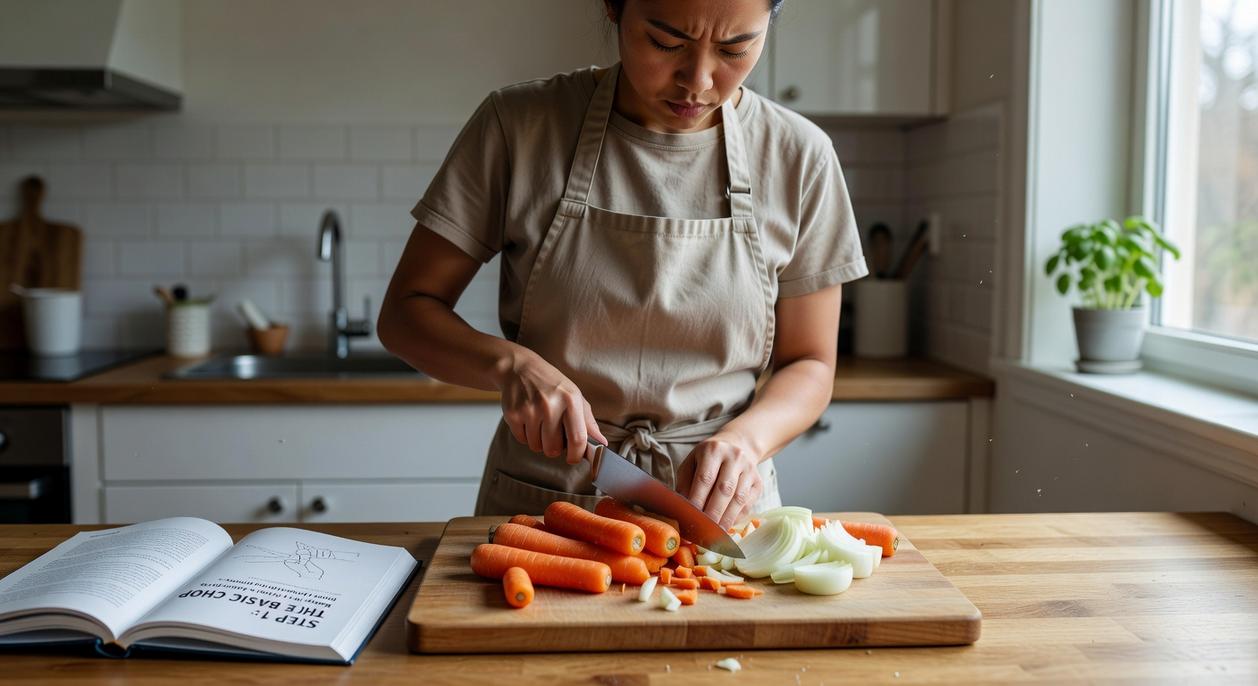
Knife work isn’t just about looking fancy on a cooking show—it’s about consistency, safety, and speed. If you’re just starting your culinary journey, mastering these 4 fundamental cuts will sharpen more than just your blade.
Let’s break them down with clear recommendations, pro tips, and a bit of flavor (the figurative kind—save the literal for the pan).
1. The Slice
This one’s your everyday MVP. Whether you’re going through zucchini, cucumber, or even tofu, remember the rocking motion: tip down first, heel follows through. It’s smooth, rhythmic, and safe (as long as you keep those fingertips tucked in).
Real-world Tip: Slicing a cucumber for pickling? A dull blade will crush it—keep your knife sharp.
2. The Dice
You’ve seen onions go from whole bulbs to perfect cubes in seconds—but how?
- First, lob off the top (not the root) and slice the onion in half.
- Peel and lay flat. Cut into even planks.
- Rotate, slice into batons, then slice again for uniform cubes.
Pro tip: Keep the root end intact while slicing to hold it all together. Less crying, more precision.
3. The Julienne (Matchsticks)
This is dicing’s artsy cousin. Think apple sticks in a slaw or carrot strips in a stir-fry.
- Trim and square off the veggie.
- Cut into planks and then slice those into thin matchsticks.
No need to go ultra-fussy here. Even matchstick-adjacent gets the job done at home.
4. The Mince
Perfect for garlic, herbs, even ginger.
- Rough chop first.
- Then, place your free hand on the back of the blade, and rock the tip back and forth across the board until finely chopped.
(It’s more about texture than uniformity—no one’s inspecting your parsley under a microscope.)
Our recommendation? Start slow and practice one technique at a time. These cuts form the backbone of recipe prep. They’re essential for flavor distribution and even cooking.
If you want to turn kitchen chaos into meal prep zen, pairing these skills with practical strategies like these meal prep hacks to save time all week long will level up your efficiency.
Get these basics down and you’re already ahead of most home cooks. This is where true knife skills for beginners begins.
Putting It Into Practice: Your First Cutting Board ‘Workout’
Ready to go from spectator to slicer? Let’s break it down into a simple three-part drill using common ingredients you probably already have. Think of it as your kitchen warm-up—minus the sweatband. This routine is ideal for building confidence with knife skills for beginners.
Your Step-by-Step Cutting Board Circuit
-
Start with Onions
Why? Their layered structure naturally guides your cuts. Begin by halving and peeling. Next, slice horizontally, then vertically—finally, cut down straight for a perfect dice. (Tip: A sharp knife = fewer tears.) -
Move to Carrots
Carrots teach you control. Slice them in half lengthwise to create a stable base (wobbly rounds are a hazard waiting to happen). From there, try sticks (julienne) or half-moons. -
Finish with Herbs
Grab a bunch of parsley or cilantro. Gather them tightly, curl your fingers, and use a rocking motion to mince. Focus on clean, repeated motions—not racing the clock.
Pro tip: Practicing on scraps or oddly shaped veggies reduces pressure (and dinner stress). Keep calm and chop on.
From Novice to Confident Home Chef
When you first stepped into the kitchen, the knife probably felt more like a hazard than a tool. That hesitation—the fear of slipping, the slow pace, the uneven cuts—was real. We get that.
But now? You’ve got the foundation. You’re no longer guessing. You’ve learned the core techniques that every confident home chef relies on—starting with proper hand positioning and essential slicing methods.
Control comes with consistency. By leaning into the knife skills for beginners—using the ‘claw grip’, ‘pinch grip’, and practicing your julienne, dice, and chop—you’ve moved beyond fear and into flow.
You came here looking for safety and speed in the kitchen. You leave empowered.
Here’s what to do now: Put what you’ve learned into action. Grab an onion, master that dice, and feel your confidence grow. You’re not just cooking anymore—you’re transforming how you cook.
 Deyvanna Zelthanna writes the kind of kitchen prep mastery content that people actually send to each other. Not because it's flashy or controversial, but because it's the sort of thing where you read it and immediately think of three people who need to see it. Deyvanna has a talent for identifying the questions that a lot of people have but haven't quite figured out how to articulate yet — and then answering them properly.
They covers a lot of ground: Kitchen Prep Mastery, Global Food Trends, Culinary Pulse, and plenty of adjacent territory that doesn't always get treated with the same seriousness. The consistency across all of it is a certain kind of respect for the reader. Deyvanna doesn't assume people are stupid, and they doesn't assume they know everything either. They writes for someone who is genuinely trying to figure something out — because that's usually who's actually reading. That assumption shapes everything from how they structures an explanation to how much background they includes before getting to the point.
Beyond the practical stuff, there's something in Deyvanna's writing that reflects a real investment in the subject — not performed enthusiasm, but the kind of sustained interest that produces insight over time. They has been paying attention to kitchen prep mastery long enough that they notices things a more casual observer would miss. That depth shows up in the work in ways that are hard to fake.
Deyvanna Zelthanna writes the kind of kitchen prep mastery content that people actually send to each other. Not because it's flashy or controversial, but because it's the sort of thing where you read it and immediately think of three people who need to see it. Deyvanna has a talent for identifying the questions that a lot of people have but haven't quite figured out how to articulate yet — and then answering them properly.
They covers a lot of ground: Kitchen Prep Mastery, Global Food Trends, Culinary Pulse, and plenty of adjacent territory that doesn't always get treated with the same seriousness. The consistency across all of it is a certain kind of respect for the reader. Deyvanna doesn't assume people are stupid, and they doesn't assume they know everything either. They writes for someone who is genuinely trying to figure something out — because that's usually who's actually reading. That assumption shapes everything from how they structures an explanation to how much background they includes before getting to the point.
Beyond the practical stuff, there's something in Deyvanna's writing that reflects a real investment in the subject — not performed enthusiasm, but the kind of sustained interest that produces insight over time. They has been paying attention to kitchen prep mastery long enough that they notices things a more casual observer would miss. That depth shows up in the work in ways that are hard to fake.